
We have a new PMBOK Guide. It is now the 8th edition of our project management “bible.” Continuing the religious metaphor, one could say that this edition shows clear signs of a counter reformation. Many elements familiar from earlier editions have returned. Before we discuss what has come back, let us briefly recall the history of the original reformation. PMI could not remain indifferent to the growing fascination with Agile, its sense of lightness and flexibility, and the shift from documentation toward interaction between project teams and other stakeholders. For a long time, the typical PMI approach had been associated with what the organization itself, for a short period, referred to as the traditional approach, meaning not modern, not current and some would say outdated.
Already in 2017, the 6th edition of the PMBOK Guide was released together with the Agile Practice Guide, which was the result of collaboration between PMI and the Agile Alliance. The structure and content of the PMBOK Guide itself, however, did not fundamentally change. As with the introduction of the 5th edition, which replaced the 4th edition four years earlier, the number of processes increased. The 4th edition contained 42 processes, the 5th edition had 47 and the 6th edition included as many as 49 processes. The content continued to expand as well. One could say that the book kept growing. The 4th edition had 506 pages, the 5th edition had 619 pages and the 6th edition, including the Agile Practice Guide, reached 976 pages. Despite this growth, it was still the same familiar PMBOK Guide built on a process based approach.
The transformation of the standard in PMBOK® 7 and its consequences
In 2021, the winds of reformation swept away the existing process based structure, and PMI introduced an approach built on principles and domains. The explanation for this revolutionary shift can be found in the introduction to the 7th edition. The authors considered it necessary to justify the change, and the key paragraph of that explanation is included below. The book also presents a graphic to clearly illustrate the transformation. Although I had long been accustomed to the process based approach from earlier editions and felt the impact of this change quite strongly, I had to admit that it also brought certain positive aspects. One of them, perhaps the most noticeable, was that for the first time the PMBOK Guide became genuinely easy to read from beginning to end. The process based perspective, however, did not disappear for long. In 2023, PMI published Process Groups: A Practice Guide, which contains all 49 processes and became another recommended resource for those preparing for the PMP exam.
The shift from processes to principles as the foundation of the new PMBOK®
Although effective in supporting good practices, process based standards are by their nature prescriptive. Since project management is changing faster than ever before, the process approach used in previous editions can no longer reflect the full spectrum of value delivery in an effective way. This edition therefore moves to a principles based approach in order to support effective project management and to place greater emphasis on expected outcomes rather than deliverables. For clarity, outcomes are understood here as the results produced through the use of the deliverables, in other words, the products created by the project.
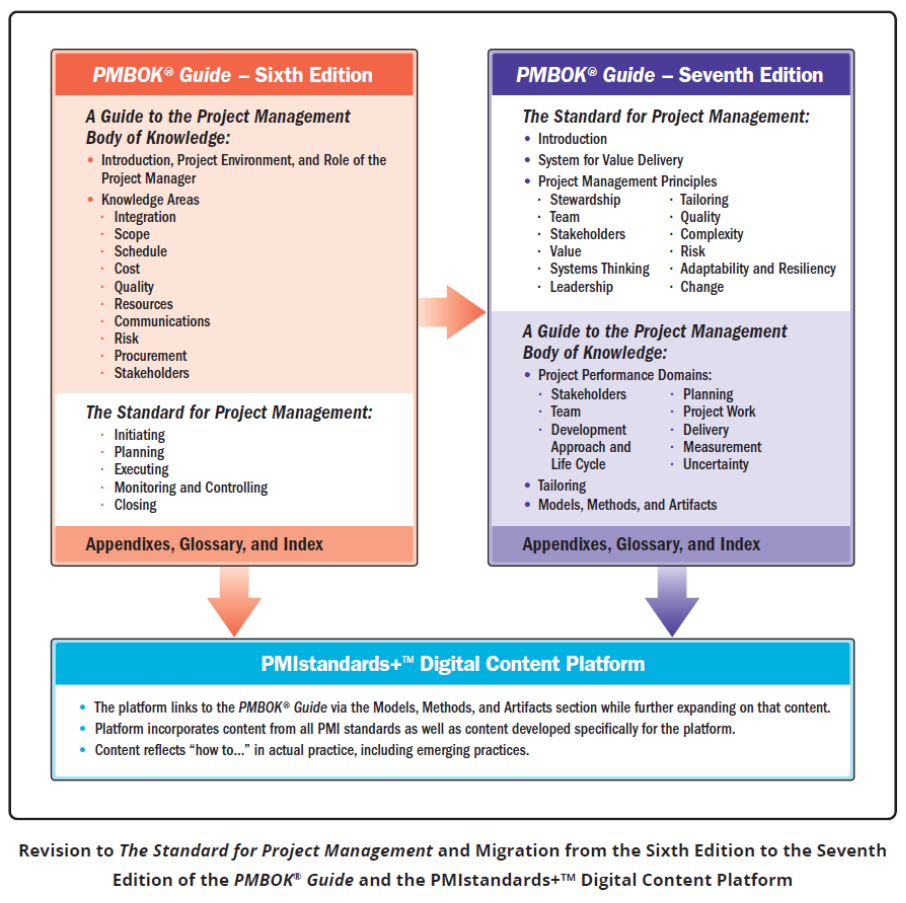
The revolution of principles and domains in the PMI® approach
Where does this leave us today, at the end of 2025? The simplest answer is that with the 8th edition, processes are returning to the PMBOK Guide. It is not possible, however, to simply revert to the previous path, which means that the current edition is a hybrid that combines principles and domains with a process based perspective. It is not a simple mixture but a new approach inspired by earlier editions and designed to respond to the challenges of the modern world, where the market quickly verifies whether our solutions deliver business value, even in traditionally structured industries. A strong emphasis on delivering business value is one of the defining elements of the current 8th edition of the PMBOK Guide.
The return of processes in PMBOK® 8 and the new integrated approach
Below you will find the key graphic for me, taken from the 8th edition, which presents the current PMI approach. At the center of this approach is the project management mindset, which consists of a proactive attitude, a sense of ownership and a value driven focus. The proper project management mindset is intended to permeate six principles: apply a holistic approach, focus on value, ensure the quality of processes and products, act as a responsible leader, incorporate sustainability into all areas of the project and build a culture of shared leadership.
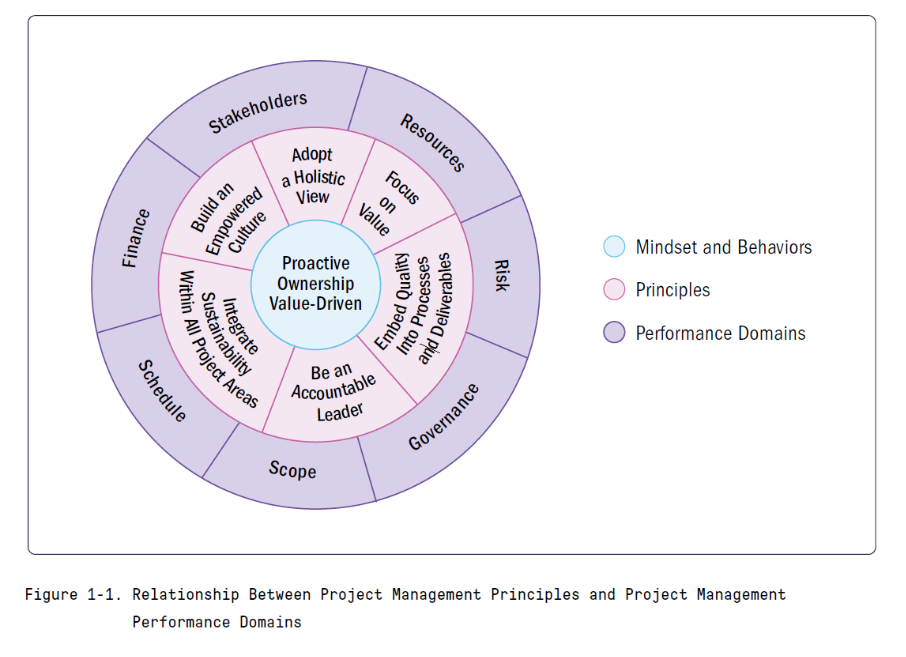
The principles are intended to serve as guidance for the actions carried out within the individual domains, which include project governance, scope, schedule, finance, stakeholders, resources and risk. These actions have been organized into 40 processes that not only refer back to the familiar structure of inputs, tools and techniques, and outputs, but are also arranged according to the traditional PMI categorization, which is now referred to as project management focus areas: initiating, planning, executing, monitoring and controlling, and closing.
Key tools and practices described in PMBOK® 8
After the section dedicated to processes, the 8th edition presents the key tools that have been recommended by PMI for many years. The entire new PMBOK Guide is contained within 401 pages, which is good news for anyone who wants to understand the PMI approach or prepare for the PMP exam. Once again we have a single, cohesive reference book that presents the knowledge required from a project manager in a sufficiently accessible way. Of course, there is always room to explore further and in greater depth. Additional standards and practical guides published by PMI continue to play an important role. However, the primary point of reference is now clearly defined. We have a new PMBOK Guide.
Article written by:
Maciej Krupa
Project Manager, Senior Consultant
PMP®, PRINCE2®, AgilePM® Accredited Trainer

 Polski
  English