

Implementing Asana—a seemingly simple task of launching a new work tool in an enterprise—can actually be a huge challenge. It shouldn't surprise anyone that for large organizations, this process can take months, engaging employees at every level and requiring thorough preparatory analysis. And when you add process mapping, project portfolio management, and training for regular users and Super Users, it suddenly becomes a digital transformation.
In the age of global digitization, large companies face a challenge that goes far beyond simple software selection. When your company employs hundreds or thousands of employees and your project portfolio encompasses dozens of strategic initiatives, introducing a new tool becomes an operation at the heart of the business. Implementing Asana in a large organization has never been just about installing an app, but rather a comprehensive change in work culture. That's why choosing the right partner, one with not only technical expertise but also years of business experience, determines whether the investment will yield a return or become another dead cost.
Scale Matters: The Challenges of Digital Transformation in Enterprises
Large companies face challenges that smaller organizations often overlook. Information silos, a lack of transparency in progress reporting, and finally, so-called tool fatigue are common symptoms that cross-departmental teams must cope with. Implementing a project management system becomes a necessary step when traditional communication methods are no longer sufficient.
A partner with years of experience in the market understands that in large corporations, technology must go hand in hand with process. An experienced expert focuses not only on software features but also on how to integrate them into the existing business ecosystem. This approach makes Asana implementation in a large organization a component of a broader digital transformation strategy, rather than just an isolated IT project.
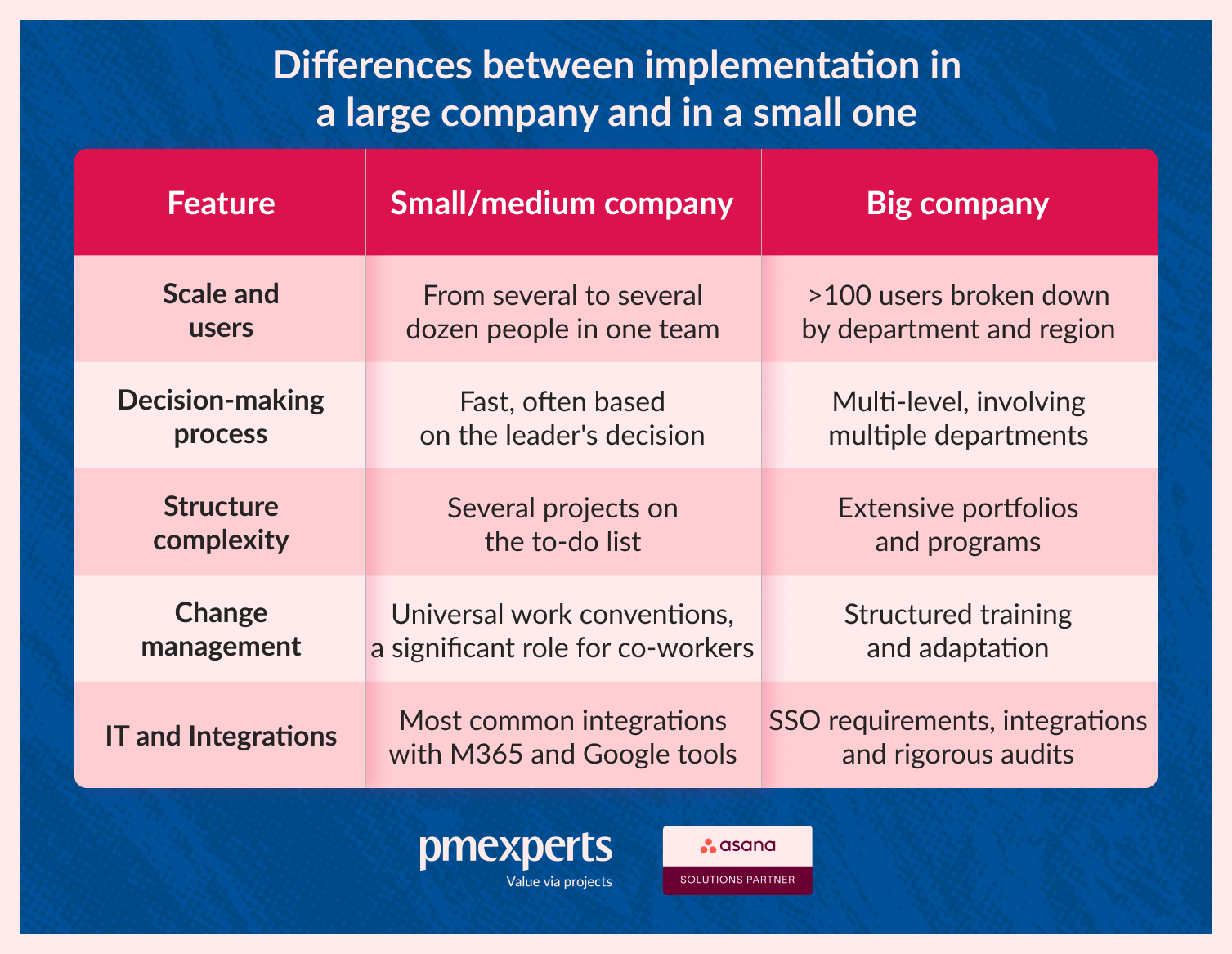
Differences between implementation in a large and small company
In smaller teams, implementing a new tool often resembles a quick setup: we purchase access, migrate processes, develop a universal set of rules, conduct training, and simply get started. However, in larger organizations, the situation is completely different.Here, every configuration error has a multiplier impact. While in a small company, a mistake in project structure can be fixed in five minutes, in a corporation, it can paralyze reporting for the entire management board or impede the work of hundreds of people simultaneously. An experienced implementation partner understands these nuances: they know how to bypass information silos, how to reconcile IT department requirements with business needs, and how to ensure the system becomes the single source of truth in a maze of scattered data.
Implementation of Asana in line with the work methodology
Implementing a tool without a solid methodological foundation is a sure path to chaos. Effectively implementing Asana in a large organization requires combining familiarity with the tool with the project management standards developed by your team. If you've been working with Kanban boards, Asana should be adapted to further support these views. If your work is repetitive, working in Asana should be template-based.
For 20 years, we've completed hundreds of projects for our clients and have never seen the same implementation twice. Despite the similarities and universal principles that should be adhered to, the work conventions developed in Asana were, in almost every case, individual.
How to convince a team to use Asana in a large organization?
The biggest barrier to implementing IT systems in large companies is team resistance to changing habits. A new tool is a new reality that requires stepping outside of your comfort zone. A professional implementation partner acts as a change agent. They understand the benefits individual team members will gain from implementing Asana and can communicate them.
Working with organizations with hundreds of employees involved in Asana, we often notice huge differences in work style, openness to change, and fluency in using virtual tools. This first factor in particular—work culture—means each department must be approached separately. These teams inherently face different challenges, have different daily work routines, and often (not always) possess a distinct set of characteristics. For example, when preparing to implement the system, it may turn out that the marketing team is highly fluent in using tools, but has too many. In such a case, we should focus on the appropriate division of tools and integration between them. We would do the opposite if we discovered that this team works primarily on paper and whiteboards. This means a different system configuration, different training options, and different implementation time.
Experience that builds trust
References from market leaders aren't just logos in a portfolio. They're proof that a partner can navigate the rigorous security procedures, complex decision-making structures, and high quality requirements typical of corporations. Having implemented projects for nearly two decades, we've learned that transparency and communication are the foundation of trust. Clients must be assured that the offer is comprehensive, free from hidden costs, and that the supplier possesses expertise in digital transformation within a large company.
Practical guide: How to prepare for implementation?
Before you sign a contract with a partner, make sure your selection process covers key aspects:
- Project maturity analysis: Check what stage your organization is at and what it really needs.
- Verification of methodological competencies: Does the partner have PMI® or AgilePM® accreditations? Implementation expertise doesn't end with familiarity with the tool.
- Availability of case studies: Has the company already implemented systems in your industry or in organizations of a similar scale?
- Defining deadlines and priorities: Implementation can sound overwhelming – but it doesn't have to be. You can always start with a pilot, emphasizing the appropriate focus so as not to disrupt your natural workflow. Choose the department and process where you'd like to test the solution.
Summary
The decision to choose a partner to implement Asana in a large organization is strategic. An experienced Solution Partner is not only a license provider, but above all, an advisor who will help guide your company through the digital transformation process safely and effectively.
By combining project management expertise, expert PM consulting, and tailored training, we'll create a work environment that allows your organization to fully realize its potential. We invite you to contact our experts to discuss how Asana can support your business goals.

 Polski
  English