
Asana implementation is often associated with configuring the tool, adding users, creating projects, preparing templates and training the team. This is an important stage, but on its own it does not guarantee improved organisational effectiveness. If Asana is treated merely as a new place to store tasks, it can very quickly become yet another system running alongside e-mails, spreadsheets, messengers and status meetings.
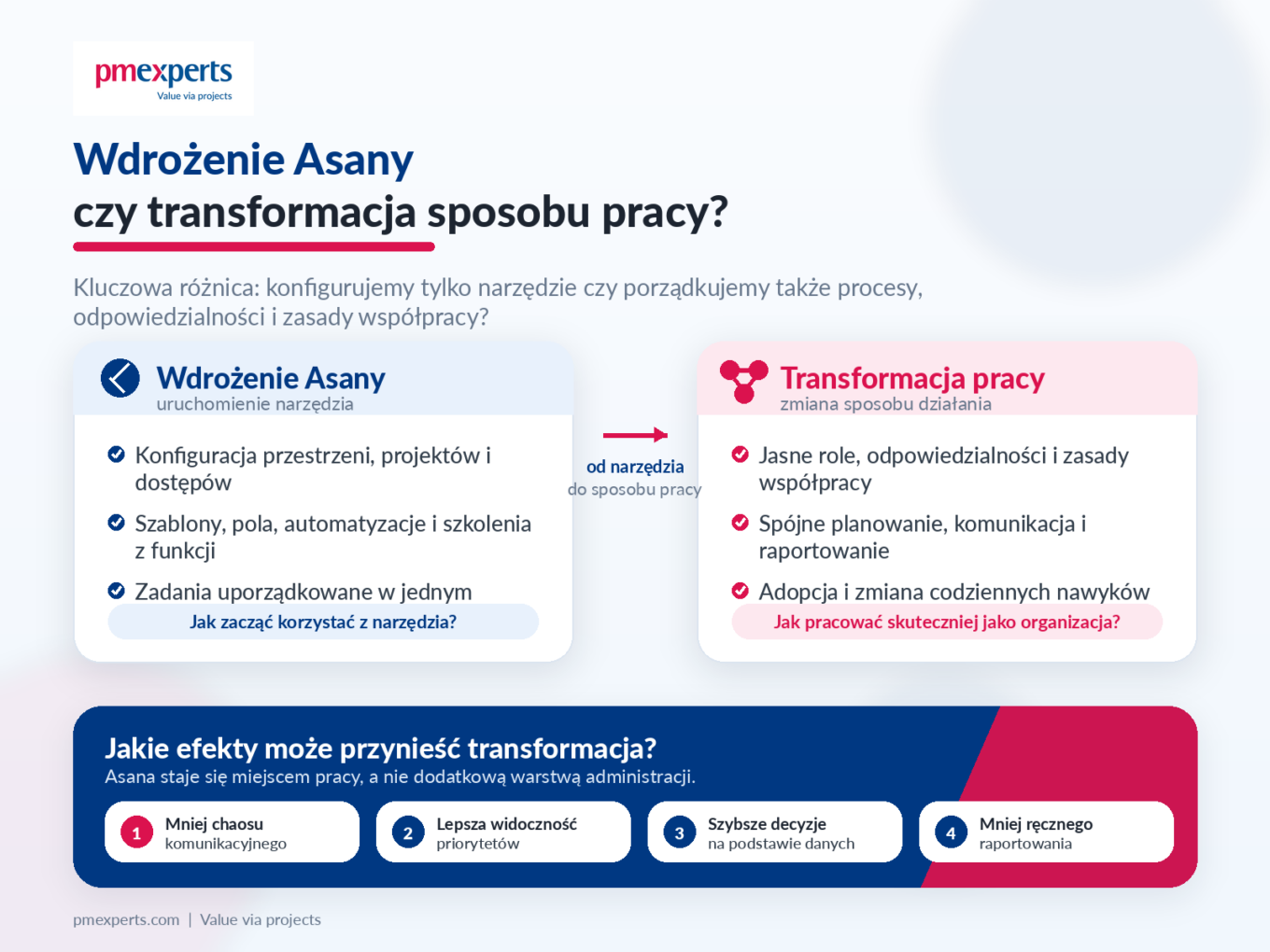
The difference between implementing Asana and transforming the way you work lies in the scale of change. Implementation mainly answers the question: how do we start using the tool? Transformation goes a step further and focuses on how to organise planning, communication, collaboration and reporting in the organisation, using Asana to support this change.
That is why simply launching Asana is not enough for an organisation to start working more efficiently. Technology can create the conditions for greater transparency, but it is clear processes, responsibilities and rules of collaboration that determine whether the tool actually starts delivering business value.
What is Asana implementation?
Asana implementation is the process of preparing the tool technically and organisationally for work in the company. It usually includes configuring the workspace, creating teams and projects, granting access, developing basic templates, setting up custom fields and automations, and running user training.
At this stage, the organisation learns how to use Asana in everyday work. The team gets to know the system's basic features and learns how to create tasks, assign responsibilities, set deadlines, use project views and track progress.
A well-executed Asana implementation helps organise the first areas of work and reduce scattered information. However, it does not automatically solve problems that stem from a lack of shared operating principles. If, before the implementation, the organisation had unclear responsibilities, inconsistent processes, too many meetings or chaotic communication, the tool alone will not remove these challenges.
It may even make them more visible.
What is transforming the way you work with Asana?
Transforming the way you work with Asana means a broader organisational change. It is not just about moving tasks to a new system but about building a more transparent and effective model of collaboration.
In practice, this means organising processes, roles, responsibilities, how work is planned, communication between teams and progress reporting. Asana then becomes not only a task management tool but part of a bigger change in how the organisation operates.
Transformation with Asana answers the questions:
- How do we plan work within teams and across teams?
- Where should up to date information about tasks, projects and priorities be stored?
- Who is responsible for specific actions and decisions?
- How do we report progress without too many meetings and manual data collection?
- How do we reduce communication chaos and increase work visibility?
- How do we ensure that leaders have access to current information needed to make decisions?
- How should Asana be integrated with the other tools the organisation uses?
Only the answers to these questions make it possible to use Asana's full potential.
Asana implementation vs work transformation – the key difference
Asana is like a well-prepared football pitch: it provides the space, structure and tools to play. But even the best pitch is not enough if the team does not know who plays in which position, how they work together, when to pass the ball and what tactics to follow.
Asana implementation organises the tool. Transformation organises the way the game is played. It defines the rules of collaboration, responsibilities, the flow of information and how decisions are made. Without it, an organisation can have a system, projects, templates and dashboards and still operate in chaos.
That is why simply launching Asana does not yet mean that the company will start working more transparently and effectively. As in sport, the result is not decided by stepping onto the pitch but by how well the team can work together.
Why is tool configuration alone not enough?
Many organizations implement a new tool expecting a quick improvement in efficiency. The problem is that a tool does not automatically change the way people work.
If the team previously reported statuses in several places, after implementing Asana it may keep doing the same, just with an additional system. If decisions were made without clear data, Asana will not change this unless rules for updating information are established. If responsibilities were blurred, simply assigning tasks is not enough for the team to understand who makes decisions, who approves results and who is responsible for communicating with stakeholders.
The most common problems after implementing Asana stem not from the tool itself but from the lack of an agreed way of working. Users know how to click around in Asana, but they don't always know why it matters and which processes they should run in it. It is not clear to them what information should go into a task, when the status should be updated, where decisions should be made and which data is the source of truth for leaders.
In such a situation, Asana does not become the source of truth about the organisation's work. It becomes an additional administrative layer.
When does an organisation need more than an Asana implementation?
Implementing the tool alone may be enough if the organisation already has mature processes, clearly defined roles and a well-functioning communication model. In that case, Asana can simply organise work in one place and make day-to-day task management easier.
A deeper transformation is needed when the organization’s problems are not only about tools, but about the way it operates.
It is worth considering transformation if situations like these often occur in the organization:
- tasks and agreements get lost in emails, messengers or meeting notes,
- teams work in different tools and it is difficult to determine the current status of activities,
- leaders do not have current visibility into project progress,
- reporting requires manual collection of information from many sources,
- responsibilities are unclear or dispersed,
- status meetings take up too much time,
- processes differ between teams and are difficult to scale,
- implemented tools are not used consistently,
- employees treat the system as an additional obligation, not as real support for their work.
In such cases, Asana can be a very effective tool for change, but only if its implementation is combined with organising the way of working.
What does work transformation with Asana look like in practice?
Transformation with Asana should start with understanding how the organisation currently operates. Before configuring the tool, it is worth checking how teams plan work, where they store information, how they report statuses, how they make decisions and which areas generate the most chaos.
Only on this basis can the target way of working in Asana be designed. It includes, among other things, the structure of teams and projects, standards for creating tasks, and rules for using custom fields, views, statuses, portfolios, automations and dashboards. It is also important to define which information users should update, how often and for what purpose.
However, transformation does not end with configuration. What matters most is adoption of the tool, i.e. teams genuinely embracing the new way of working. This includes change communication, role-specific training, support for leaders, monitoring Asana usage and gradually improving processes.
In a well-run transformation, Asana becomes the natural place for operational and project work. Teams know where to look for information, leaders have access to up-to-date data, and reporting no longer relies on manually asking employees about the status of tasks.
What results can transformation with Asana bring?
A well-executed transformation of the way of working using Asana helps increase the transparency of activities in the organisation. Teams better understand priorities, responsibilities and dependencies between tasks. Leaders gain greater control over progress without having to hold excessive status meetings.
One of the most important effects is reducing communication chaos. Information about tasks, deadlines, owners and decisions is stored in one place, making it easier to return to agreements and check the current status of work.
Transformation can also improve the quality of reporting. If the data in Asana is up to date and filled in consistently, the organisation can identify delays, team overload, risks and dependencies between projects more quickly. This in turn makes it easier to make decisions based on facts rather than incomplete or outdated information.
In the longer term, Asana can support building a more mature work culture: one based on transparency, accountability and better collaboration between teams.
The role of leaders in transformation with Asana
One of the key conditions for a successful transformation is the involvement of leaders. If Asana is to become real support for the organisation, it cannot be seen only as an operational tool for delivery teams.
Leaders should clearly communicate why the organisation is changing the way it works, which problems it wants to solve and what role Asana will play. It is also important that they themselves use the data available in the system, for example during status reviews, management meetings or discussions about priorities.
If leaders still expect reports prepared outside Asana, teams will quickly conclude that the tool is not the main source of information. If, on the other hand, decisions are made based on data from Asana, motivation to keep tasks, statuses and projects up to date increases.
Transformation of the way work gets done therefore requires not only user training, but also a change in management habits.
The most common mistake: treating implementation as an IT project
The most common mistake when implementing Asana is treating the whole process like an IT project that ends when the system goes live. The organisation can then tick off configuration, user access, templates, automations and training, yet still lack a shared way of running its work.
At first, everything may look fine. Projects have been created, users have access and the team knows where to click. The problem appears after a few weeks, when everyone starts using the system in their own way. Some update statuses regularly, others only before a meeting. Some decisions are made in comments, some by e-mail and some during conversations that are never recorded. Dashboards exist, but they don't show the full picture because the data is not filled in according to a common standard.
This is the moment when it becomes clear that tool implementation and changing the way work gets done are two different levels of action.
That is why, before implementation or in parallel with it, it is worth asking a few questions:
- What problems do we want to solve with Asana?
- Which processes need to be organized?
- What information should be visible to teams, leaders and the management board?
- Who is responsible for keeping data up to date?
- How should Asana be integrated with other tools?
- How will we measure the effectiveness of implementation?
- Which behaviors and habits should change?
Without answers to these questions, implementation may end in technical success, but organizational disappointment.
Asana as a tool supporting change
Asana can significantly improve how an organisation works, but its value depends on how it is embedded in everyday processes. It can support the management of tasks, projects, campaigns, operational processes, portfolios of initiatives and reporting. It can also help teams reduce the number of meetings, organise communication and increase the visibility of work.
However, it will not replace a conversation about how the organization wants to work. It will not resolve priority conflicts if there is no process for setting priorities. It will not improve decision making if it is unclear who is responsible for what. It will not provide reliable reports if data is not updated regularly.
That is why the best results come when the Asana implementation is part of a broader transformation of the way of working.
Implementation or transformation: what does your organisation need?
Not every company needs a broad transformation straight away. Sometimes an efficient Asana implementation, organising a few basic processes and training the team is enough. This applies especially to organisations that already have clear rules of collaboration but need a better tool for managing tasks and projects.
However, if the problems concern communication, responsibilities, visibility of activities, reporting or collaboration between teams, it is worth treating Asana as part of a bigger change. Then the goal is not just to launch the system but to improve the way the organisation works.
This is the difference between moving tasks to a new place and building an environment in which teams work more consciously, transparently and effectively.
From tool implementation to changing the way work gets done
Implementing Asana and transforming the way you work are not the same thing. Implementation lets you start using the tool. Transformation lets you use it to genuinely improve how the organisation works.
Configuring the system, preparing templates and training users are not enough if the way of planning, communicating, reporting and making decisions does not change. Asana can be effective support for an organisation, but only when combined with clear processes, responsibilities and consistent change management.
So working with Asana is not only about technology. It's about people, processes and changing everyday organisational habits.
Asana can be the beginning of an important change, provided that we treat the implementation as part of a broader transformation of the way of working.

 Polski
 English