
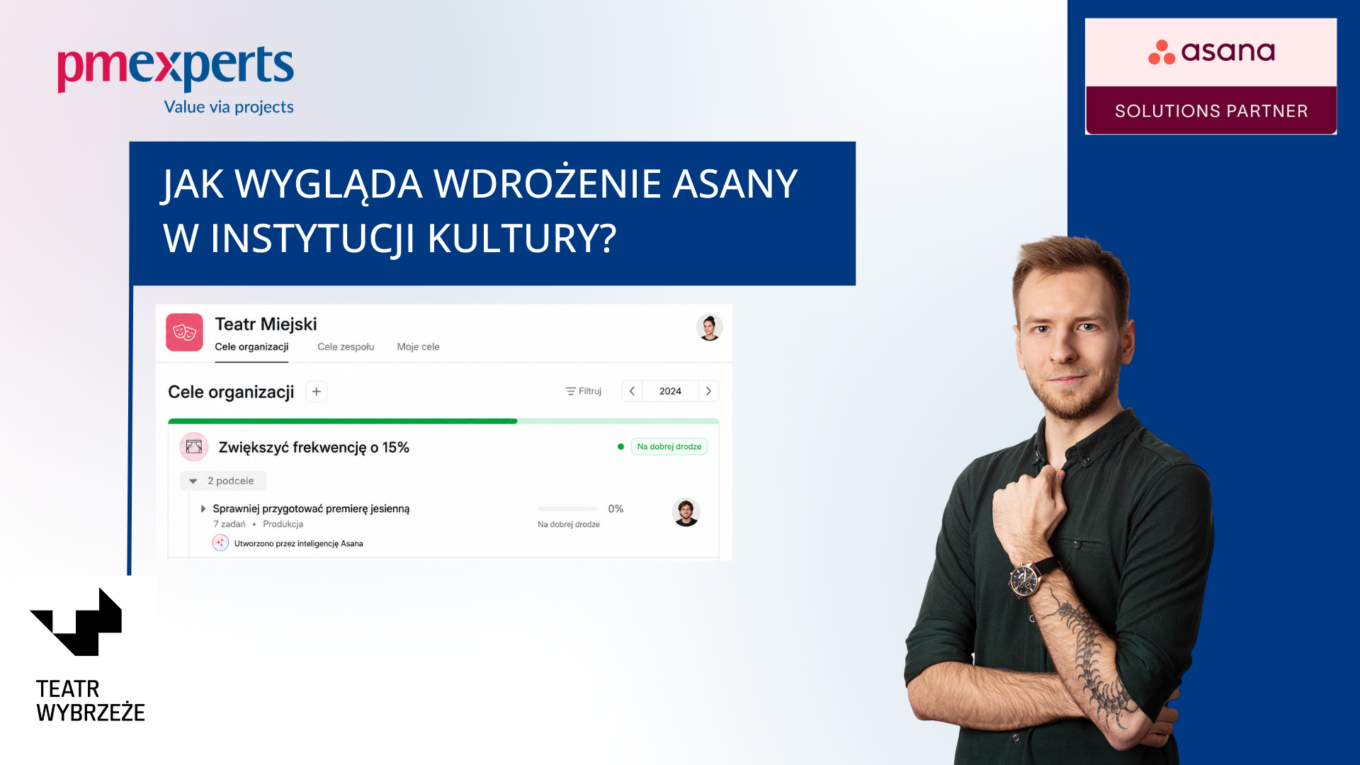
A conversation with Monika Mioduszewska about implementing the tool, working on premieres and festivals, and why patience is key in managing change.
Behind every performance and event there is the complex work of many people, while preparations for the next premieres are under way in parallel. At Teatr Wybrzeże, the need to organise this process became the impulse to implement Asana. We talk to Monika Mioduszewska, head of the communication and education department, about the challenges of the first months, everyday use of the tool and the results after two years.
How did the story of implementing Asana at Teatr Wybrzeże begin?
First came the need, and only later knowledge of a specific tool. Almost three years ago, I took over a large team in the communication and education department. It quickly turned out that the number of projects was so large that working solely through e-mails and individual notes was no longer enough.
So we started looking for a solution that would help us organise and streamline our work. I analysed various tools and began to look more closely at Asana. Later we contacted pmexperts and started the implementation. It was a very natural process: we needed one place that would keep us from getting lost in hundreds of notes scattered across different tools.
What has implementing Asana changed in the team's everyday work?
Asana has systematised and organised a large part of our work. Running a theatre is a complex process. On the one hand, we have day-to-day operations, organising performances and events, and on the other, production work on the next premieres is constantly going on in the background. With so many parallel activities, everyone has to know what they need to do and what stage a given project is at.
As a manager, I needed a solution other than phoning everyone or sending lots of separate messages. I wanted a shared space where the whole team has access to the information they need. As a result, the flow of information has become easier and the work more transparent.
Did the team like the new tool from the start?
No, the beginnings were quite bumpy. The team was still forming: some people had already worked at the theatre, and some were new. On top of that, everyone had their own habits and used different ways of organising their work. Implementing Asana was therefore not only a change of tool but also a change of shared habits.
Today I am a very satisfied Asana user, and the team has also been won over. At this point, I don't think anyone can imagine us working without this tool. It's a good lesson that things don't always have to be easy at the beginning, but it's worth it.
What helped guide the team through this change?
Above all, patience. When everyone has a lot on their plate, introducing a new tool can initially look like a step backwards. But you have to invest in learning and agreeing on rules in order to take two steps forward later.
From a manager's perspective, it was important for me to give people space, answer questions calmly and discuss feedback together. We held many meetings devoted to how we want to work in Asana. Among other things, we used a form of contract, similar to those used in workshops. We agreed what the tool is for, how quickly we respond to tasks, which matters we discuss as a team and which individually.
It was also very important to set boundaries around notifications. In the theatre we work irregular hours, often in the evenings too. The mere fact that someone receives a notification at 9 p.m. does not mean they have to react immediately. Once we agreed on these rules together, work became much smoother and more comfortable.
How do you use Asana day to day in the theatre?
Both for communication and for planning work on events and projects. Contrary to appearances, a theatre is an organisation like any other: you have to plan activities, coordinate the work of many people and keep track of successive stages of delivery.
Every premiere or festival is a large project divided into many smaller tasks. A good example is the Wybrzeże Sztuki festival, whose preparation and delivery begin at least six months before the event. The number of steps to complete is then very large. Asana helps us carry them out step by step, without unnecessary stress.
I would highly recommend such solutions to cultural institutions. People sometimes joke that we are great at organising events but not always equally good at organising our own work. Yet the more things are planned, anticipated and visible to the team, the easier it is to run complex projects without adding extra pressure.
How do you rate Asana after two years? Is your way of working still evolving?
Above all, over these two years we ourselves and our way of working have changed. We no longer think day to day about how to use Asana. It has become a natural, organic part of how the team functions.
Asana itself is also evolving. Recently we started using new AI features, including summaries and the ability to quickly extract the most important information. These are solutions that did not exist when we started the implementation.
That said, we approach this without pressure. We don't have to use every new feature straight away. We introduce them gradually, to the extent that they genuinely support our work. We certainly still have many possibilities to discover.
Thank you for the conversation – and we warmly invite you to Teatr Wybrzeże.
The story of Teatr Wybrzeże shows that implementing Asana is not just a change of tool but, above all, a way to organise the team's work, improve the flow of information and reduce chaos across many parallel projects — from day-to-day activities, through premieres, to large events and festivals. If tasks, e-mails and notes in your organisation are starting to live a life of their own, let's talk about how Asana can help your team work more calmly, transparently and effectively. Contact us and find out how we can support the implementation of Asana in your company.

 Polski
 English