Many pages have already been devoted to the dynamics of change in today's world. We are all aware that we live in an era of growing uncertainty. This prompts us to look for the right answer both in our private and professional lives. Companies, of course, also have to find their own answers to this challenge. In recent years, I have often heard the statement: The bosses expect us to be more agile. This certainly shows how big a career the concept of “agile” has made since the creation of the Agile Manifesto, or rather the “Manifesto for Agile Software Development” (agilemanifesto.org) in February 2001. But are agile project management methods the straightforward answer? As you might expect, complex reality does not give us the comfort of simple answers and universally applied schematic solutions.
Challenges of the modern labor market
A good example of the pace of change in today's world is the World Economic Forum's Future of Jobs Report 2025, published on January 7, 2025. The report identified five key factors influencing the labor market. We are living in a time of global political uncertainty and a retreat from international free trade. Technological progress and the green transformation have become a permanent part of our daily lives. We are also seeing a demographic shift in the labor market, as the number of employees approaching retirement age is increasing. The key concepts are change and uncertainty. We are experiencing changes in attitudes and moods, in tools and solutions, and in the age structure of society. Change requires us to abandon our established habits, which inevitably leads to uncertainty about the future. Tomorrow may turn out to be better or worse than today, but it will certainly be different. This requires us to adapt to new conditions. The fast pace of change forces us to respond with speed and flexibility.
From forecasting to flexibility: the evolution of methodologies
Developed in the 1950s and 1960s, project management methodologies focused on the importance of predicting the future and building plans which, based on reliable forecasts, were supposed to enable an effective – or at least more effective – matching of resources to the work required to deliver the undertaking successfully. However, by the late 1980s and early 1990s, in software development – a new and rapidly developing field of science and business – it was noticed that the predictive approach did not work. Resource allocation plans could not keep up with the dynamics of technological change, in which new technical possibilities appeared in a short span but of course required further competent people to deliver them. Following the new technical possibilities, ideas about possible applications changed, and with them the expectations of specific systems and solutions. The answer was the emergence of agile, or adaptive, ways of organising work.
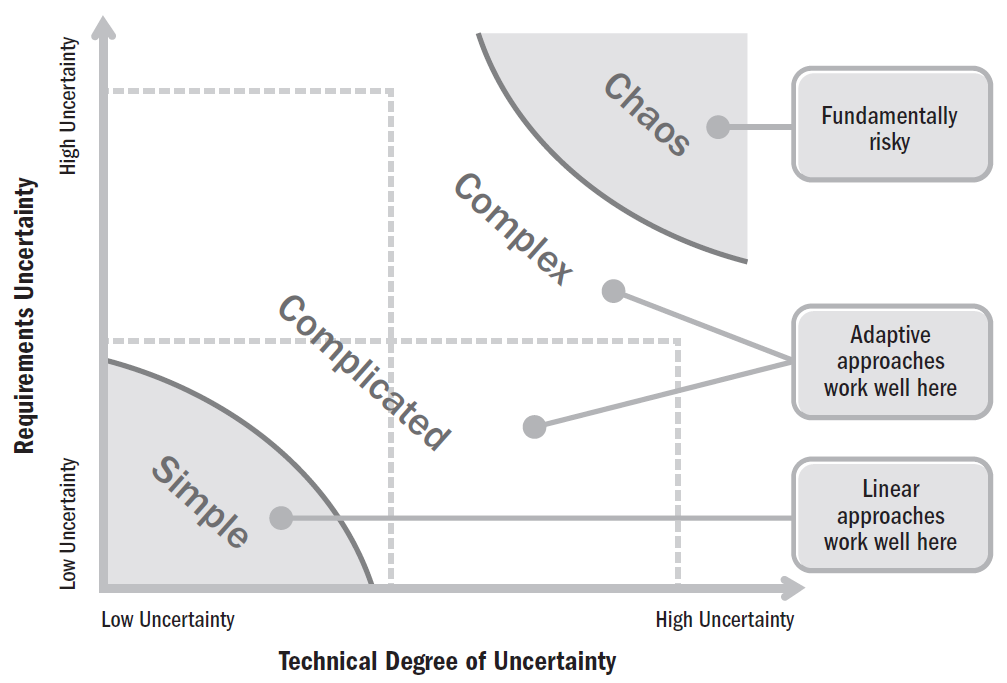
Uncertainth and Complexity Model Inspired by the Stacey Complexity Model
Source: Agile Practice Guide, 2017, Project Management Institute
Agile approaches: opportunities and limitations
Traditional project management methodologies were based on a sequential or linear arrangement of project activities in the following order: planning, execution, review, and implementation. In contrast, adaptive methodologies emphasized the overlap between planning and execution. This allowed for easier course correction based on the review of completed work, instead of continuing with long-term but misguided solutions. According to the 17th State of Agile Report (https://digital.ai/resource-center/analyst-reports/state-of-agile-report), Scrum remains the most widely used agile framework in the world. Its core principle is adapting to results and adjusting plans no less frequently than once a month. At the same time, the same report shows that more and more organizations around the world, especially medium-sized and large ones, are facing significant barriers in implementing Agile in software development. As a result, they are choosing various alternative frameworks tailored to their specific context.
Why is this happening if, as we have already mentioned, the world is becoming increasingly complicated and complex? First of all, it is important to emphasize that agile approaches, although highly dynamic, still rely on certain assumptions about stable elements of work organization. For example, they assume a fixed development team and a fixed scope of work for a defined period of time, typically no longer than one month. As we can conclude from the diagram referenced earlier, this model will not work in completely chaotic conditions. On the other hand, even in chaotic environments, companies usually cannot afford large-scale changes within a short time frame. Due to tax regulations, annual budget planning remains the standard, which significantly limits the flexibility of organizations.
Hybridization as a response to complexity
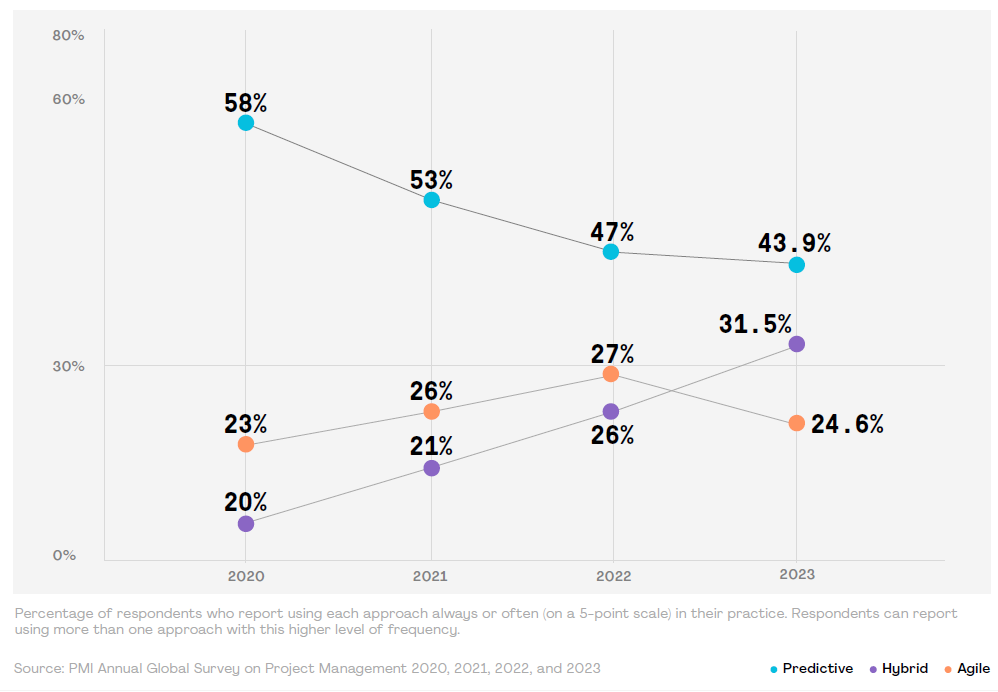
The Project Management Institute (PMI) report Pulse of the Profession® 2024 presents an interesting overview of the use of traditional project management methodologies, meaning predictive approaches, and agile methodologies. The data is based on research conducted across various organizations, including those outside the IT sector. It clearly confirms the trend described earlier in the 17th State of Agile Report. The use of purely agile methods has stopped growing and has even started to decline. The use of predictive methodologies had already been decreasing for some time. However, this does not mean that organizational chaos has taken their place. On the contrary, there is a visible and steady rise in the popularity of hybrid methodologies. These are based on processes tailored to the specific characteristics not only of an industry but also of each organization’s working conditions.
Practical guidance: how to choose methodologies for your organization
The concept of a hybrid approach emphasizes the combination of predictive and adaptive elements within one work structure. Although this type of approach can be found in existing formal project management frameworks such as AgilePM, both of the reports mentioned above highlight that organizations are now focused on designing their own internal systems. These systems freely combine practices inspired by both traditional and agile models. The key to selecting and integrating elements from the predictive and adaptive toolbox lies in aligning them with the external environment and the internal structure of the organization.
Given that these conditions are likely to continue changing due to global dynamics, it is worth adopting a philosophy of small steps and continuous improvement. It is highly unlikely that we will be able to fully abandon annual budgeting. However, we can analyze how much detail is truly necessary in planning to support effective medium-term decision-making. Agreed margins for adjustment can allow for significant flexibility even during the execution of an annual budget. And even if the budget limits our freedom, it is still worth considering the use of agile principles in both planning and team-level work. The number of possible solutions is as great as the number of individual companies and institutions. Pmexperts will gladly be your guide on this unique path.
Article written by:
Maciej Krupa
Project Manager, Senior Consultant
PMP®, PRINCE2®, AgilePM® Accredited Trainer
 Polski
 English