
Twelve months ago, the marketing team of a leading Polish press publisher completed the implementation of Asana. Today, the tool forms the foundation of their team's daily work and project management.
About project
- Industry: Media
- Number of Asana users: 25
- Asana plan: Starter
What challenges did the team face before implementing Asana?
The marketing department at a national daily publisher, like many companies operating in today's market, recognized the limitations resulting from outdated work methods. Monitoring project implementation in Excel, communication dispersed across various tools, and standardizing processes requiring improvement – these were key challenges that became increasingly burdensome as the company grew. The team decided to take action aimed not only at increasing operational efficiency but also at building a competitive advantage through higher-quality project work. That's when the press journal team discovered Asana.
The marketing department began testing Asana in a free demo, allowing the team to see if the program's functionalities met their actual needs. Asana proved to have the features and functionality the customer was satisfied with. The team decided to purchase a Starter license, as well as comprehensive implementation and training for employees in the tool.
Want to see for yourself if Asana is the right tool for your organization?Write to us!We'll help you launch your company's Asana environment and clarify all your doubts.
Asana Implementation Process
Stage 1: Initialization and Planning Phase
The implementation, like any other project, began with the collaborative creation of a Project Charter, which comprised goals, milestones, and key implementation risks. Together with the team, we defined implementation requirements based on the current state of play. Primarily, we aimed to standardize 10 selected marketing processes and optimize them in the target environment.
Stage 2: Implementation Phase
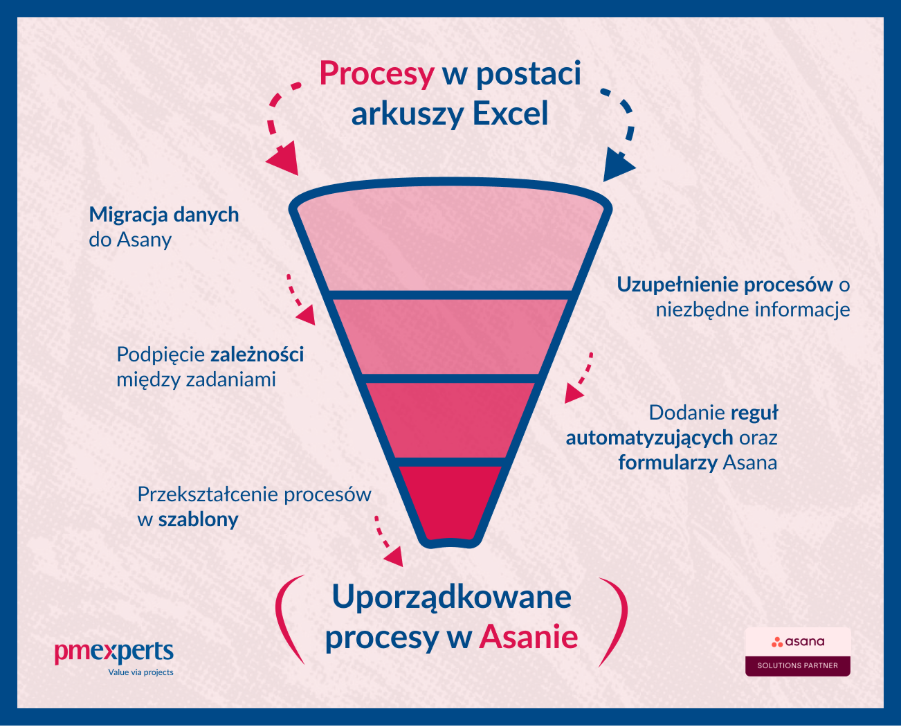
The action plan was ready – the time had come for implementation. The team began by migrating existing processes from Excel to Asana. Existing solutions were optimized by:
- supplementing them with the necessary information,
- defining dependencies between tasks,
- introducing Asana forms,
- use of automation rules,
- creating task templates for cyclical processes.
During daily meetings, we had the opportunity to continuously review the work status and quality of the transferred processes. Over time, the processes took their final shape and were transformed into reusable project templates.
Stage 3: Monitoring and Control Phase
Implementing a process into Asana doesn't mean the end of the process. It requires monitoring its implementation in practice. Together with the client's team, we regularly revisited the implemented solutions, making adjustments where necessary. This ensured that end users received solutions that were clear, intuitive, and ready for daily use.
The implementation concluded with user training. We presented the basics of working in Asana, as well as advanced features for effectively managing the work environment. This allowed workshop participants to build on what they already knew. They also received supporting instructional materials – established work practices that will help (especially at the beginning) develop good habits. The implementation team also received a set of tips and recommendations for further adaptation of the tool within the organization, as well as a process for onboarding new employees in Asana. All this was done to ensure that the client felt confident in transitioning their work environment to the new system.

What did the marketing department gain by implementing Asana?
The marketing department replaced work on numerous, scattered Excel spreadsheets with a single "My Tasks" section. A year after implementing the tool, it's clear that the transparency and structure of tasks has increased. Everyone knows what to do and by what deadline – which is often a prerequisite for timely and efficient project completion.
Thinking about implementing a project management system in your organization? Learn more about Asana implementations!



 Polski
  English